
Research reference
MOTS-C
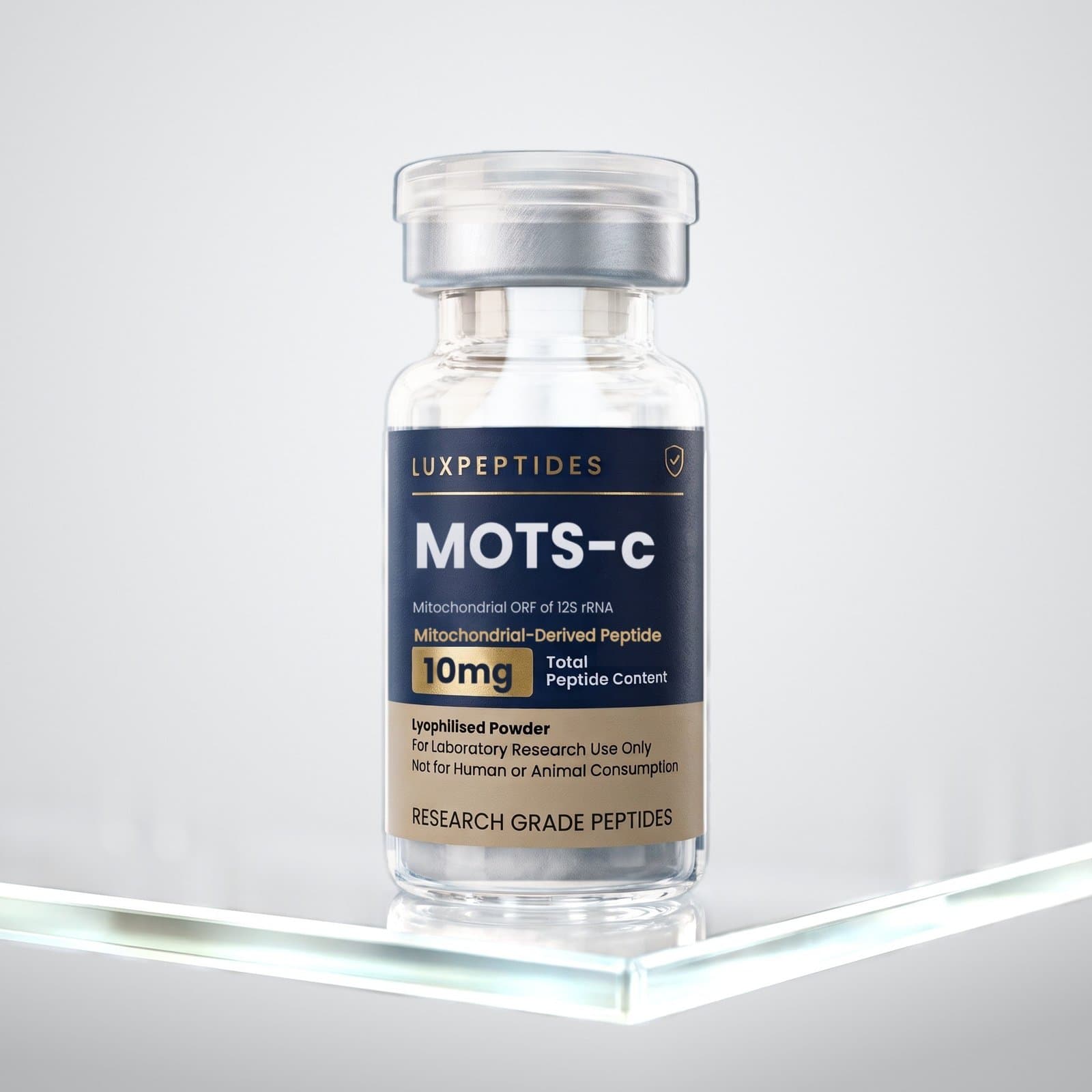
MOTS-c (mitochondrial open reading frame of the 12S rRNA-c) is a 16-amino-acid peptide encoded within the mitochondrial genome. It is supplied as a lyophilised powder for laboratory research applications only.
Molecular information
Type
Mitochondrial-derived peptide
Length
16 amino acids
Formula
C101H152N28O22S2
Weight
2174.6 g/mol
CAS
1627580-64-6
Form
Lyophilised powder
Vial sizes
10 mg / 20 mg
Classification
Mitochondrial peptide
Sequence
- 01Met
- 02Arg
- 03Trp
- 04Gln
- 05Glu
- 06Met
- 07Gly
- 08Tyr
- 09Ile
- 10Phe
- 11Tyr
- 12Pro
- 13Arg
- 14Lys
- 15Leu
- 16Arg
MRWQEMGYIFYPRKLR
Research overview
MOTS-c was first described in 2015 as a peptide encoded by a short open reading frame within the mitochondrial 12S rRNA gene. Research models use it to investigate AMPK-linked metabolic signalling, insulin sensitivity, and mitochondrial-to-nuclear communication, including its movement into the nucleus under metabolic stress. It is also studied in exercise and ageing research.
Common research focus areas
Laboratory research use only
This product is supplied strictly for laboratory research use. It is not a medicine, food, cosmetic, or dietary supplement, and is not for human or animal consumption. Any use outside a documented laboratory research protocol is prohibited.
Handling
For laboratory use, reconstitute with a sterile diluent appropriate to the research protocol, introducing the diluent slowly against the vial wall to minimise peptide degradation. Do not shake.
Published research
- The mitochondrial-derived peptide MOTS-c promotes metabolic homeostasis and reduces obesity and insulin resistanceLee C et al. · Cell Metabolism · 2015 · Discovery, preclinicalPMID 25738459
- The mitochondrial-encoded peptide MOTS-c translocates to the nucleus to regulate nuclear gene expression in response to metabolic stressKim KH et al. · Cell Metabolism · 2018 · PreclinicalPMID 29983246
- MOTS-c is an exercise-induced mitochondrial-encoded regulator of age-dependent physical decline and muscle homeostasisReynolds JC et al. · Nature Communications · 2021 · Preclinical and human observationalPMID 33473109
- MOTS-c: a mitochondrial-encoded regulator of the nucleusBenayoun BA et al. · BioEssays · 2019 · ReviewPMID 31378979
- Mitochondrial-encoded peptide MOTS-c, diabetes, and aging-related diseasesKong BS et al. · Diabetes and Metabolism Journal · 2023 · ReviewPMID 36824008
- MOTS-c: a promising mitochondrial-derived peptide for therapeutic exploitationZheng Y et al. · Frontiers in Endocrinology · 2023 · ReviewPMID 36761202
Evidence status
Most published research on MOTS-c has been carried out in mice and cell models. Human data is largely limited to measurements of naturally occurring MOTS-c levels, for example during exercise. MOTS-c is not approved by any medicines regulator and is named on the World Anti-Doping Agency Prohibited List as an AMPK activator.