Research reference
SEMAX
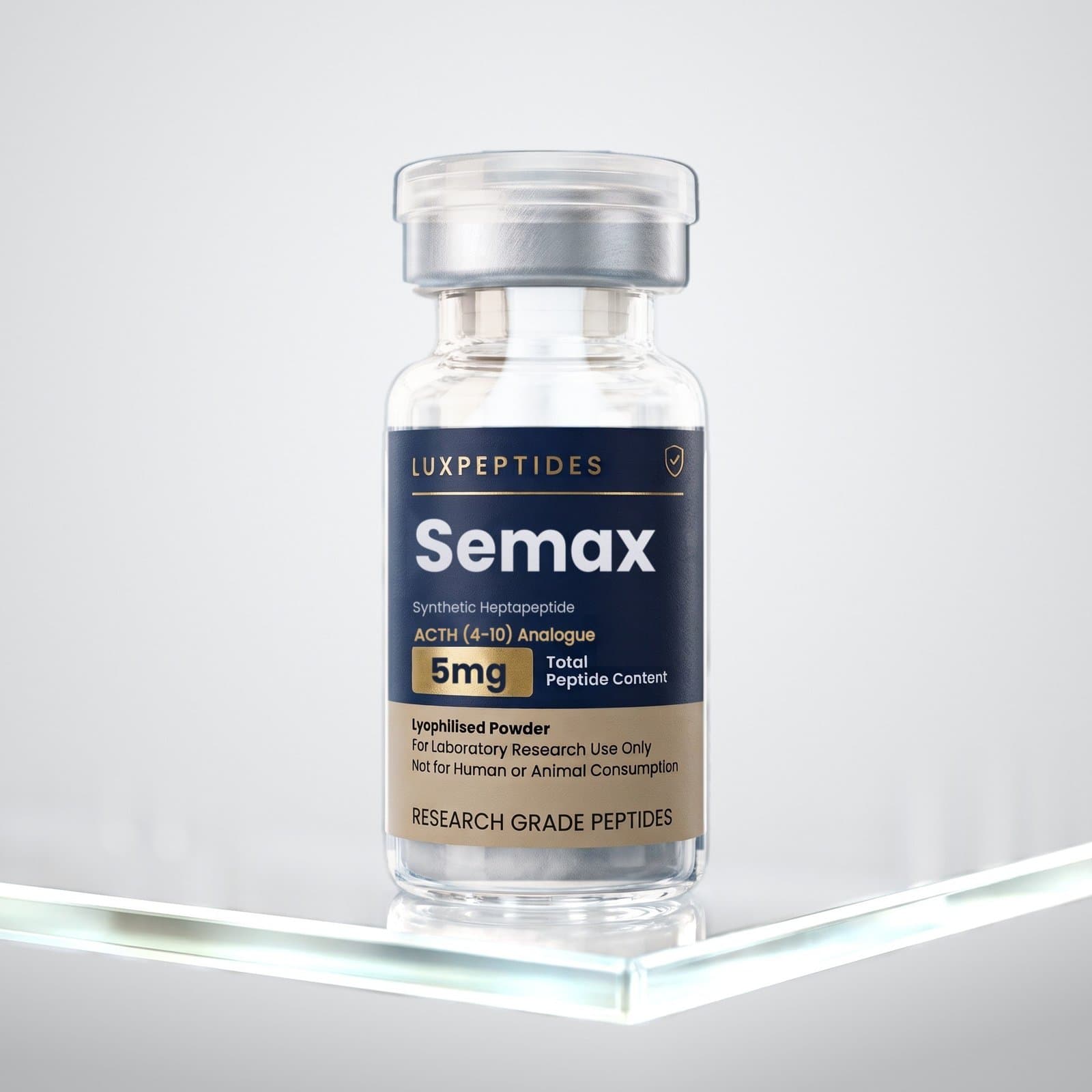
Semax is a synthetic heptapeptide analogue of the ACTH(4-7) fragment, extended with a Pro-Gly-Pro tail. It is supplied as a lyophilised powder for laboratory research applications only.
Molecular information
Type
Heptapeptide
Length
7 amino acids
Formula
C37H51N9O10S
Weight
813.9 g/mol
CAS
80714-61-0
Form
Lyophilised powder
Vial sizes
5 mg / 10 mg
Classification
Neuropeptide analogue
Sequence
- 01Met
- 02Glu
- 03His
- 04Phe
- 05Pro
- 06Gly
- 07Pro
MEHFPGP
Research overview
Semax was developed in Russia in the 1980s. The Pro-Gly-Pro tail added to the ACTH(4-7) fragment slows enzymatic breakdown, and the peptide has no meaningful hormonal activity at the adrenal glands. Laboratory research focuses on its effects on neurotrophin expression, including BDNF, and on gene expression changes in models of cerebral ischaemia.
Common research focus areas
Laboratory research use only
This product is supplied strictly for laboratory research use. It is not a medicine, food, cosmetic, or dietary supplement, and is not for human or animal consumption. Any use outside a documented laboratory research protocol is prohibited.
Handling
For laboratory use, reconstitute with a sterile diluent appropriate to the research protocol, introducing the diluent slowly against the vial wall to minimise peptide degradation. Do not shake.
Published research
- Brain Protein Expression Profile Confirms the Protective Effect of the ACTH((4-7))PGP Peptide (Semax) in a Rat Model of Cerebral Ischemia-ReperfusionSudarkina OY et al. · International Journal of Molecular Sciences · 2021 · Animal studyPMID 34201112
- The effect of semax and its C-end peptide PGP on expression of the neurotrophins and their receptors in the rat brain during incomplete global ischemiaStavchanskiĭ VV et al. · Molecular Biology (Moscow) · 2011 · Animal studyPMID 22295573
- The efficacy of semax in the tretament of patients at different stages of ischemic strokeGusev EI et al. · Zhurnal Nevrologii i Psikhiatrii imeni S.S. Korsakova · 2018 · Clinical studyPMID 29798983
Evidence status
Most published research on Semax comes from Russian research groups, and much of it appears in Russian-language journals. It is registered as a medicine in Russia but is not approved by the MHRA, EMA or FDA. Independent controlled clinical data are limited.